
Navigating Motions for Electronic Witness Testimony at the WCAB
A procedural guide to motion practice, witness-specific good cause, evidentiary safeguards, and preservation of error following the WCAB's Tyson Perez en banc decision.
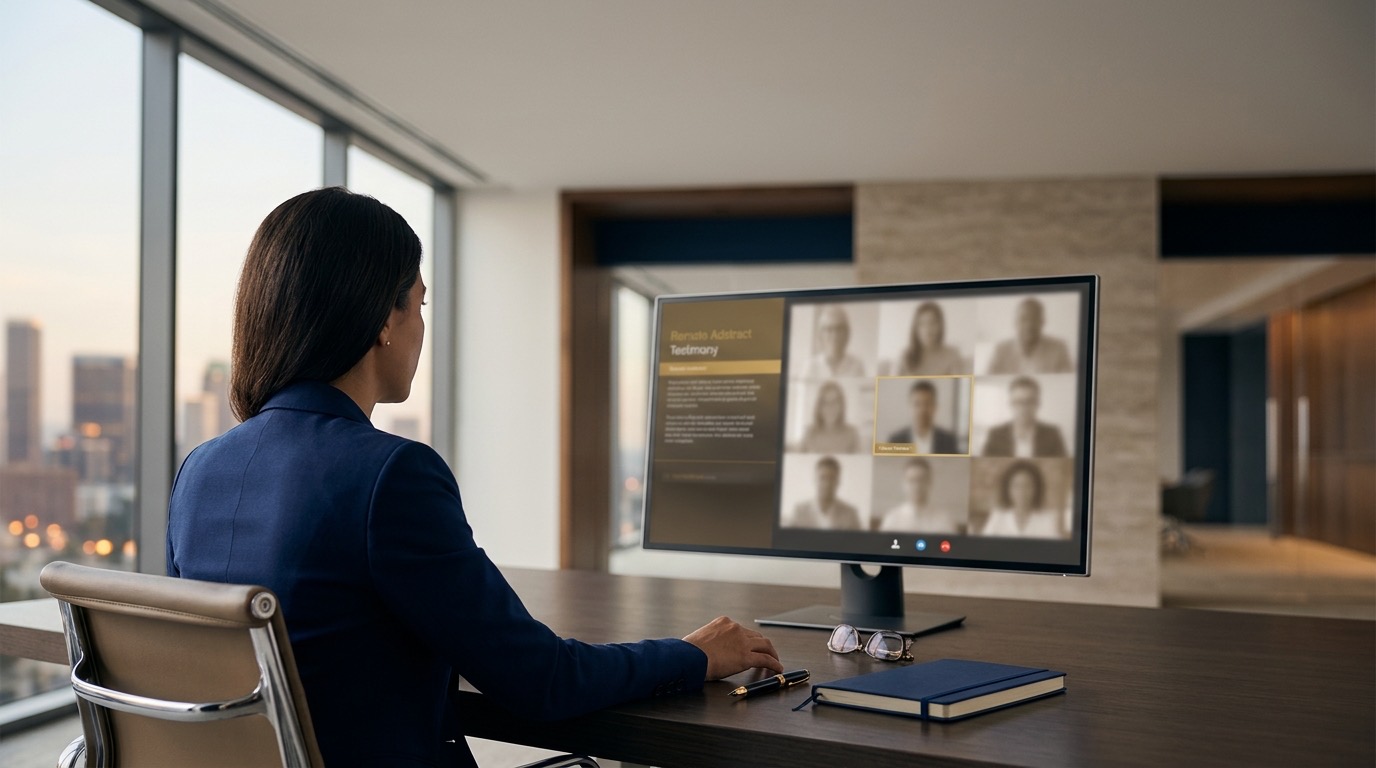
Securing remote or electronic witness testimony at Workers' Compensation Appeals Board (WCAB) hearings requires strict compliance with formal motion practice and evidentiary safeguards. Parties cannot rely on informal administrative requests or assume that virtual appearances will be granted as a matter of routine. Instead, electronic testimony requests must be presented through written petitions that establish specific, witness-level good cause and detail operational integrity measures for the proceeding.
The foundational decision governing this motion practice is Tyson Perez v. Webcor Construction, ADJ16597333 (2025-EB-02), issued as a binding en banc decision by the WCAB (WCAB En Banc Decision). Practitioners must accurately represent what Perez decided and what it did not. The en banc Board granted reconsideration and issued a preliminary conclusion establishing that Workers' Compensation Administrative Law Judges (WCALJs) must adjudicate formal petitions for electronic witness testimony on their merits rather than summarily rejecting them. The WCAB explicitly deferred its final decision on the underlying substantive merits of the dispute after granting reconsideration. Perez therefore establishes a binding procedural floor—petitions must be heard—but does not itself resolve the substantive standard for when electronic testimony must be granted or denied. Practitioners should not represent Perez as having resolved the merits of any particular electronic-testimony request.
Statutory Framework: Labor Code Sections 5700 and 5703
California workers' compensation trial proceedings are governed by statutory mandates that protect due process and cross-examination rights. Under Labor Code Section 5700, trials must be conducted open to the public, and parties possess the explicit right to present evidence and cross-examine witnesses. Labor Code Section 5703 specifies the categories of written and testimonial evidence admissible before the Board.
Neither Section 5700 nor Section 5703 expressly addresses electronic testimony, which is why the procedural framework established in Perez and applicable WCAB Rules of Practice and Procedure fills the gap. When a party seeks to present witness testimony electronically—whether via video conference or telephonic platform—the moving party must file a formal written petition under those rules. Filing an oral motion on the day of trial is disfavored and frequently results in summary denial or a continuance, creating avoidable delay and potential fee exposure for the requesting party.
Establishing Witness-Specific Good Cause and Timely Filing
To prevail on a motion for electronic testimony, the petitioning party must present concrete, witness-specific facts establishing good cause. Generalized assertions that electronic testimony is convenient or cost-effective are insufficient. The petition should be supported by declarations addressing factors specific to the individual witness, including:
- Geographic Distance: Detailed facts confirming the witness resides outside California or at a distance from the relevant WCAB district office that makes in-person attendance unreasonably burdensome, with supporting documentation such as a declaration from the witness or counsel.
- Medical Hardship or Disability: Verified medical documentation or a treating physician statement establishing that traveling to or attending an in-person hearing presents a genuine health risk to the witness.
- Unavailability or Professional Constraints: Evidence of scheduling conflicts—such as an expert witness's court-ordered appearance in another jurisdiction—that cannot be remedied through reasonable trial rescheduling.
- Proportionality and Testimony Scope: An explanation that the witness's testimony is limited to foundational or non-complex factual matters where the WCALJ's direct observation of physical demeanor is less critical to the credibility determination.
Petitions should be served on all opposing parties and filed with the WCAB well in advance of the mandatory settlement conference (MSC) or trial setting. Early filing gives the court adequate time to evaluate opposition arguments and schedule a formal hearing on the petition before the trial date.
Electronic-Testimony-Specific Credibility Controls, Technology Safeguards, and Exhibit Management
A primary defense objection to remote witness testimony centers on credibility assessment and document security. Opposing counsel frequently argue that virtual testimony hinders effective cross-examination, conceals off-camera coaching, or complicates exhibit identification and authentication. These objections are distinct from general witness-preparation concerns and must be addressed in the motion record itself.
A comprehensive petition for electronic testimony should affirmatively propose the following safeguards, each of which is specific to the electronic-testimony context:
- Camera Placement and Room Integrity: Requiring the witness to maintain a clear, wide-angle camera view showing the full room environment so the WCALJ and opposing counsel can verify that no unauthorized persons or unapproved reference materials are present during testimony.
- Exhibit Pre-Marking and Digital Exchange: Pre-marking all proposed trial exhibits with agreed exhibit numbers and serving identical electronic binders on the witness, opposing counsel, and the court before the hearing date, so that exhibit identification during cross-examination is unambiguous.
- Interpreter Coordination: Where the witness requires a certified court interpreter, establishing simultaneous translation protocols in advance and confirming that the interpreter possesses an identical digital document set to avoid delays during examination.
- Technical Failure Protocol: Specifying backup telephonic lines and establishing on the record that any technical interruption will result in an immediate recess rather than continuation of unrecorded or partially recorded testimony.
These safeguards directly address the credibility and due-process objections most commonly raised in opposition. Proposing them affirmatively in the petition shifts the burden to the opposing party to articulate why the proposed safeguards are insufficient for the specific witness and testimony at issue.
Filing Formal Opposition and Preserving Record Errors
Attorneys opposing a motion for electronic witness testimony must build a clear evidentiary record to preserve objections for appellate review. Effective oppositions identify specific prejudice to the cross-examination process—for example, that the witness's credibility is the central disputed issue, that impeachment will rely on physical documents requiring real-time authentication, or that prior inconsistent statements require direct, in-person confrontation to be effectively presented.
If a WCALJ denies or grants a petition for electronic testimony over objection, the aggrieved party must preserve the error on the trial record. Under Labor Code Section 5700 and the petition procedures under Labor Code Section 5909, counsel must state explicit objections on the trial minutes, submit a written offer of proof detailing the expected impact on cross-examination, and preserve the issue for a subsequent Petition for Reconsideration. A general objection stated only orally and not memorialized in the minutes may be insufficient to preserve the issue for review.
Checklist: Electronic Witness Testimony Motion Preparation
Practitioners preparing or opposing remote witness testimony motions should use the following checklist to ensure procedural and statutory compliance before the WCAB.
| Motion Preparation Phase | Required Action Items | Statutory and Regulatory Basis |
|---|---|---|
| 1. Pre-Motion Audit | Identify witness location, travel constraints, medical records, and specific scope of testimony to be presented electronically. | WCAB Rules of Practice and Procedure; Tyson Perez (2025-EB-02) |
| 2. Petition Drafting | Draft formal written petition detailing witness-specific good cause with supporting factual declarations; do not rely on generalized convenience arguments. | Labor Code § 5700; Tyson Perez (2025-EB-02) |
| 3. Safeguard Protocol | Attach technology plan addressing camera placement, room integrity, backup telephonic lines, and digital exhibit pre-marking index with agreed exhibit numbers. | Labor Code § 5703; WCAB Rules of Practice and Procedure |
| 4. Filing and Service | File petition and serve all parties well in advance of the MSC or trial setting; do not wait until the day of trial. | WCAB Rules of Practice and Procedure |
| 5. Record Preservation | State explicit objections on trial minutes, lodge written offer of proof detailing cross-examination prejudice, and preserve issue for Petition for Reconsideration. | Labor Code § 5909 |
Understanding the Scope and Limits of Tyson Perez
The WCAB's en banc ruling in Tyson Perez (WCAB En Banc Decisions) establishes that WCALJs must adjudicate formal petitions for electronic witness testimony on their merits under due process principles rather than dismissing them summarily. That is the binding holding. What Perez did not do is equally important: the Board explicitly deferred its final decision on the substantive merits of the underlying dispute after granting reconsideration. Practitioners must not represent Perez as having established a right to electronic testimony in any particular circumstance or as having resolved the substantive standard governing when such requests must be granted.
By structuring remote testimony requests around verified, witness-specific hardship, pre-marked exhibit management, and documented technical safeguards, practitioners can satisfy the procedural threshold the WCAB has established while protecting client due process rights on both sides of the motion. For strategies on general hearing preparation and exhibit management, see our guide on trial preparation protocol. This article is for informational purposes only and does not constitute legal advice or create an attorney-client relationship.
Frequently asked questions
What did the WCAB decide in the Tyson Perez en banc decision regarding electronic testimony?
In Tyson Perez, ADJ16597333 (2025-EB-02), the WCAB granted reconsideration and issued a preliminary conclusion establishing that WCALJs must adjudicate formal petitions for electronic witness testimony on their merits rather than summarily rejecting them. The Board explicitly deferred its final decision on the underlying substantive merits of the dispute after granting reconsideration. Perez does not establish a right to electronic testimony in any particular circumstance.
What factors constitute good cause for requesting electronic witness testimony at the WCAB?
Good cause requires witness-specific facts, such as out-of-state residency at a distance making in-person attendance unreasonably burdensome, verified medical hardship preventing travel, or a scheduling conflict that cannot be resolved through reasonable rescheduling. Generalized convenience or cost arguments are insufficient.
How do you preserve an objection if a judge denies a motion for electronic witness testimony?
Counsel must state explicit objections on the trial record and minutes, submit a written offer of proof detailing the specific prejudice to cross-examination, and preserve the objection for a Petition for Reconsideration under Labor Code Section 5909. A general oral objection not memorialized in the minutes may be insufficient to preserve the issue for appellate review.
Questions about your legal options?
Mission X Trial Lawyers evaluates matters in this practice area. Call (888) 611-4683 or email office@mcxlegal.com.