
Waiting for an Exit Search in California: Which Time and Rules Matter?
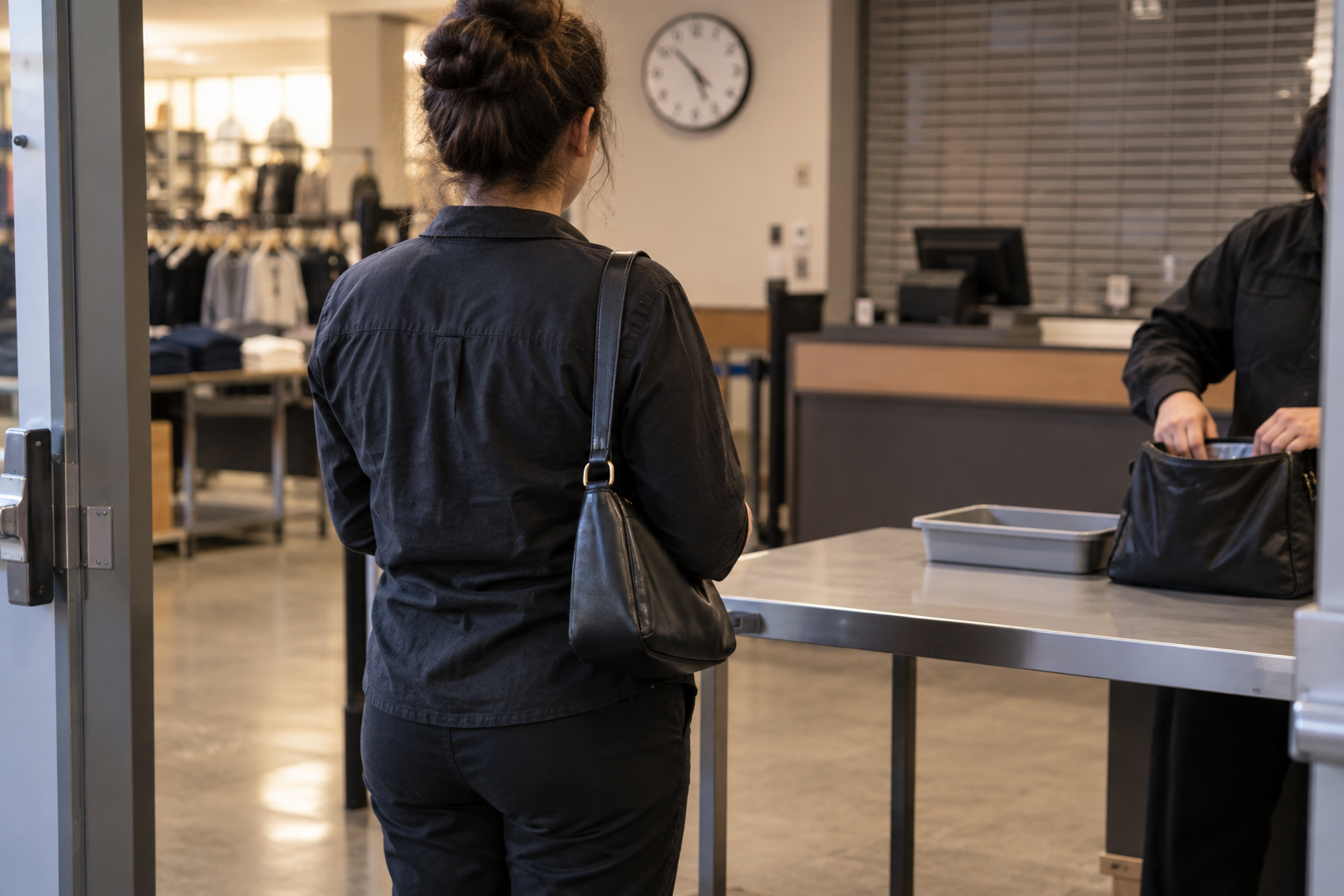
If you must clock out and then wait for an employer’s exit search in California, preserve the search policy and actual timing. A federal decision about warehouse screenings does not, by itself, resolve a California wage-order claim. California’s control-based definition of hours worked can reach time that the federal Portal-to-Portal Act treats differently.
The task is to determine which law applies and what the employer required. Record when paid time stops, where you must wait, whether you can leave, what happens if you refuse, and which belongings trigger inspection. Those facts are more useful than describing all time on the property as either automatically paid or automatically excluded.
Identify the state and federal questions separately
In Integrity Staffing Sols., Inc. v. Busk, 574 U.S. 27, 33–36 (2014), the U.S. Supreme Court held that the warehouse security screenings before it were not compensable under the FLSA. The federal inquiry focused on whether the activity was integral and indispensable to the principal work the employees were hired to perform, rather than merely required by or beneficial to the employer.
The CA Supreme Court applied a different inquiry in Frlekin v. Apple Inc., 8 Cal. 5th 1038, 1056–57 (2020). Under Wage Order 7, employees’ time on Apple’s premises waiting for and undergoing mandatory exit searches of bags, packages, and personal Apple devices was compensable. The court reached that result even though employees voluntarily brought those items for personal convenience. Read the official Frlekin opinion, especially its concluding analysis, rather than assuming that “optional bag” answers the control question.
Preserve how the search works in practice
Save the written policy and instructions about when to clock out. Note whether all employees are searched or only those carrying specified items. Describe whether a manager or guard must be found, whether exits remain restricted, and what discipline or consequences attach to leaving without inspection. Identify differences between the written policy and actual practice without assuming one cancels the other.
A search that takes thirty seconds after a ten-minute mandatory wait raises a different factual question from an immediate inspection. Record both intervals separately. A timekeeping system may capture the end of productive work while omitting the queue entirely. The wage statement will not necessarily reveal that omission on its face.
For example, an employee clocks out, waits by an exit for an available manager, opens a personal bag, and leaves after inspection. A useful record identifies the clock-out time, waiting start, manager arrival, search completion, and whether the employee could leave before approval. Do not replace observed times with a coworker’s rounded estimate.
Check the applicable wage order and claim
Frlekin interpreted Wage Order 7 in the retail setting before it. An analysis for another industry should identify the applicable wage order and any exemption or other rule, then examine the relevant control language. The case is a strong warning against importing the federal rule wholesale, but it is not a substitute for that work.
Our Busk case analysis explains the federal holding and its boundaries. The same facts may need analysis under more than one source of law. Liability, overtime consequences, penalties, limitations, and the appropriate forum should be evaluated rather than assumed from the label “off the clock.”
Reconstruct time without exaggeration
Keep a contemporaneous log of representative shifts, clearly distinguishing actual observations from estimates. Save schedules, time records, pay statements, and messages about search delays. Identify coworkers who experienced the same procedure, while preserving differences among locations, managers, shifts, and policies. A consistent method is more credible than a list that selects only the longest day.
Do not secretly record private conversations or access restricted systems to create proof. Preserve records you lawfully possess and explain missing material to counsel. An employer’s failure to record an interval can affect proof, but it does not justify inventing a duration or assuming that every employee experienced the same delay.
Practical steps for employees reviewing unpaid search time
- Identify the location, job, wage order, and pay arrangement.
- Save the search and timeclock rules, including any instruction to clock out first.
- Record waiting and inspection as separate intervals and retain the underlying dates.
- Compare the log with paid hours and preserve any corrections or complaints.
- Have counsel evaluate the California and federal claims independently.
Our employment practice page describes the firm’s work in workplace disputes. If the problem also involves inaccurate pay statements, keep that issue distinct from whether the underlying search time was paid; the evidence and legal elements may differ.
For employees, the immediate objective is a factual account of control and uncompensated time. A short log supported by the policy and time records can reveal what needs investigation. MCX Legal can review the actual exit procedure and applicable law before selecting a wage-claim strategy. Bring the policy, several representative shifts, and the associated payroll records so the consultation can focus on the disputed interval.
Questions readers ask
Does Busk mean California exit searches are unpaid?
No. Busk decided the federal FLSA issue. Frlekin applied California Wage Order 7’s control standard to the mandatory searches before it.
Does bringing a bag voluntarily defeat a claim?
Not automatically. Frlekin rejected that shortcut for the searches it considered. The actual control and applicable wage order matter.
Should I record only the search itself?
Record both required waiting and the inspection, and show where each falls relative to the timeclock and paid hours.
Review unpaid waiting and search time under the correct law
Mission X Trial Lawyers can review the records and legal issues described here. Call (888) 611-4683 or email office@mcxlegal.com.